On this page
Your car's paint code is a short string of letters and numbers that identifies the exact factory formula your car was sprayed with. It is not hidden inside your VIN — the VIN identifies the vehicle, not the color — and it almost never says “paint code” next to it. Manufacturers print it on a small label or plate somewhere on the body, and every brand picks a slightly different spot. This guide shows you exactly where to look, brand by brand.
The three places to look
Across nearly every brand, the code lives in one of three places — plus one bonus spot:
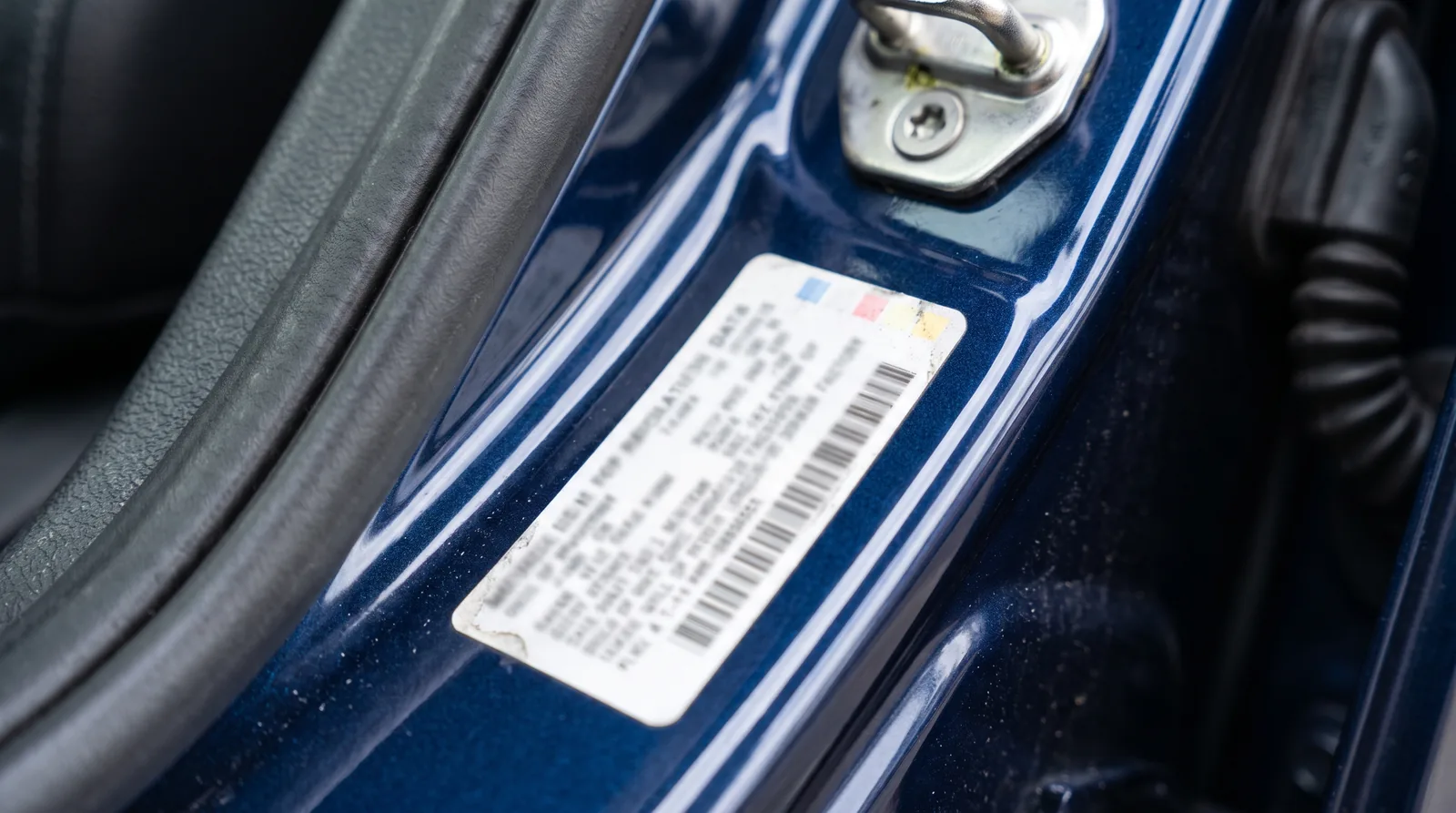
- Driver's door jamb — the body frame the door closes against, not the door panel itself. This is the most common location by far.
- Trunk — near the spare tire or under the floor cover, often on the spare wheel well.
- Under the hood — a plate or label around the radiator support at the front of the engine bay.
- Glovebox — a few brands, and many older GM vehicles, tuck a service label inside it.
How to read the label
When you open the door and find the certification label, don't expect the words “paint code.” Look for COLOR, EXT PNT, PAINT, or a short code printed near the VIN and tire pressures. Codes come in a few shapes:
- Two letters — Ford's style, like YZ for Oxford White.
- Three digits — BMW and Mercedes, like 300 for BMW Alpine White.
- Letters and numbers mixed — Toyota's 040, Jeep's PW7.
- A longer string with a trailing letter — Honda's NH731P, where the final letter often marks a pearl finish. Copy the whole thing.
Copy the code exactly as printed. A zero and the letter O look nearly identical on a stamped label, and one wrong character points to a completely different color.
Toyota & Lexus
Open the driver's door and check the certification label on the door frame. It lists the VIN and tire information, and the paint code sits next to the letters C/TR or the word COLOR — the first code is the paint, the second is the interior trim. Toyota codes are usually three characters, like 040 for Super White. Be careful with whites in particular: Toyota has offered several distinct whites, and they will not match each other.
Honda & Acura
Same spot: the driver's door jamb, on the certification label. Honda codes mix letters and numbers, like NH731P for Crystal Black Pearl. The letters before the dash or digits identify the color family (NH is neutral/black-white, B is blue, R is red), and the trailing letter matters — it usually distinguishes a pearl or metallic version. Never order Honda paint by color name alone; the lineup is full of near-identical pearls.
Ford & Lincoln
Ford puts it on the driver's door jamb label too — look for the box marked EXT PNT. Ford codes are short, often just two characters, like YZ for Oxford White. With only two characters there's little room for error, so double-check what you read. Ford has also reused codes across its car and truck lines over the decades, which is why the label on your vehicle beats any generic chart.
GM: Chevrolet, GMC, Buick & Cadillac
The GM brands share one paint system. On most vehicles the code is on the door jamb label; on older ones, open the glovebox and look for the Service Parts Identification label — a sticker densely packed with codes, where the paint code hides among the RPO codes (often prefixed BC/CC or a WA number). GM codes can run five or six characters, so write down the whole line and let your paint supplier pick out the color portion. Tell them which GM brand you drive.
Jeep, Chrysler, Dodge & Ram
The Stellantis family keeps it simple: the driver's door jamb label. Codes are usually three characters starting with P, like PW7 for Bright White. Jeeps in particular tend to need this code sooner or later — trail pinstripes are a badge of honor right up until you want them gone — so it's worth photographing the label and saving it in your phone.
Jeep codes → · Dodge → · Chrysler → · Ram →
BMW
BMW is the brand that most often surprises people: check the trunk first. Lift the floor and look at the spare wheel well cover or a nearby panel; depending on the generation, the sticker may instead be on the door jamb or in the engine bay near the strut tower. BMW codes are three or four characters, like 300 for Alpine White. One caveat: BMW Individual (custom-order) paint uses its own codes that won't appear on standard charts — confirm those through your VIN.
Mercedes-Benz
Mercedes uses a data plate rather than a simple sticker, and its position has moved around over the generations: engine bay, trunk area, or driver's door jamb. The paint code is a three-digit number printed with the other build specs, like 149 for Polar White. Mercedes has reused short numeric codes for genuinely different colors across different eras, so on an older car, have a dealer confirm the code against your VIN before ordering paint.
Nissan & Infiniti
On many Nissans the color code sits on the vehicle information plate in the engine bay, mounted on the radiator support and marked COLOR; newer models often list it on the door jamb label as well. Codes are typically three characters, like KH3 for Super Black. If the plate has collected a decade of grime, a gentle wipe is all it needs — don't scrub stamped characters with anything abrasive.
Hyundai & Kia
Both brands use the driver's door jamb label, usually with an explicit PAINT or COLOR line — one of the friendlier layouts to read. Codes run two or three characters, like S3B for Hyundai's Phantom Black. Watch the model year, though: both brands refresh colors often, and a returning color name sometimes comes back under a new code and formula.
Subaru
Check the driver's door jamb first; if the sticker is gone, Subaru also carries the code on a plate in the engine bay. Codes are compact, usually three characters, like K1X for Crystal White Pearl. Subaru reuses color names across years more than most brands, so match the code, not the name.
Older and classic cars
Before modern certification labels, manufacturers stamped the information on metal. On many American classics the paint code lives on a cowl tag — a small riveted plate on the firewall or near the base of the windshield — or on a build sheet, a paper record sometimes tucked under the seat springs or carpet, or left in the trunk. The format varies by maker and plant, and enthusiast forums for your specific model are genuinely the best decoder; a dealer VIN lookup can also recover the color on many (though not all) classics.
If you still can't find it
Label missing, repainted over, or unreadable? Two reliable fallbacks:
- A dealer's parts department can decode your VIN and tell you the original factory color — any dealer for your brand can do this in a minute.
- Paint suppliers that mix touch-up paint usually offer the same VIN lookup when you order.
And of course, you can look up your make and model here to see every factory code on record with its model years — use it to confirm what's printed on your car, not to replace checking the car itself.
Frequently asked questions
Is the paint code part of my VIN?
No. The VIN encodes the manufacturer, model, year and plant — but not the color. The paint code is tracked separately on a label or plate on the body. A dealer can, however, use your VIN to look the color up in their build records.
What does a paint code look like?
A short string of two to six letters and digits: Ford uses two letters (YZ), BMW and Mercedes use three digits (300, 149), Toyota and Jeep mix letters and numbers (040, PW7), and Honda uses longer codes with a trailing letter (NH731P). It usually appears next to the word COLOR, PAINT or EXT PNT.
Where is the paint code most often located?
On the driver's door jamb — the body frame the door closes against. That covers most brands. The main exceptions are BMW (trunk, near the spare wheel well), Mercedes (data plate in the engine bay, trunk or door jamb) and many Nissans (information plate on the radiator support).
What if the sticker is missing or unreadable?
Ask a dealer's parts department to decode your VIN — they can recover the original factory color code from build records. Many touch-up paint suppliers offer the same VIN lookup when you order.
Can I trust the paint currently on the car to match the code?
Mostly, but not always: if a panel was ever repainted after an accident, it may carry a close match rather than the exact factory formula, and even original paint fades in the sun. For repairs, painters blend into neighboring panels precisely because a fresh mix of the correct code can sit next to aged paint and still look slightly different.