On this page
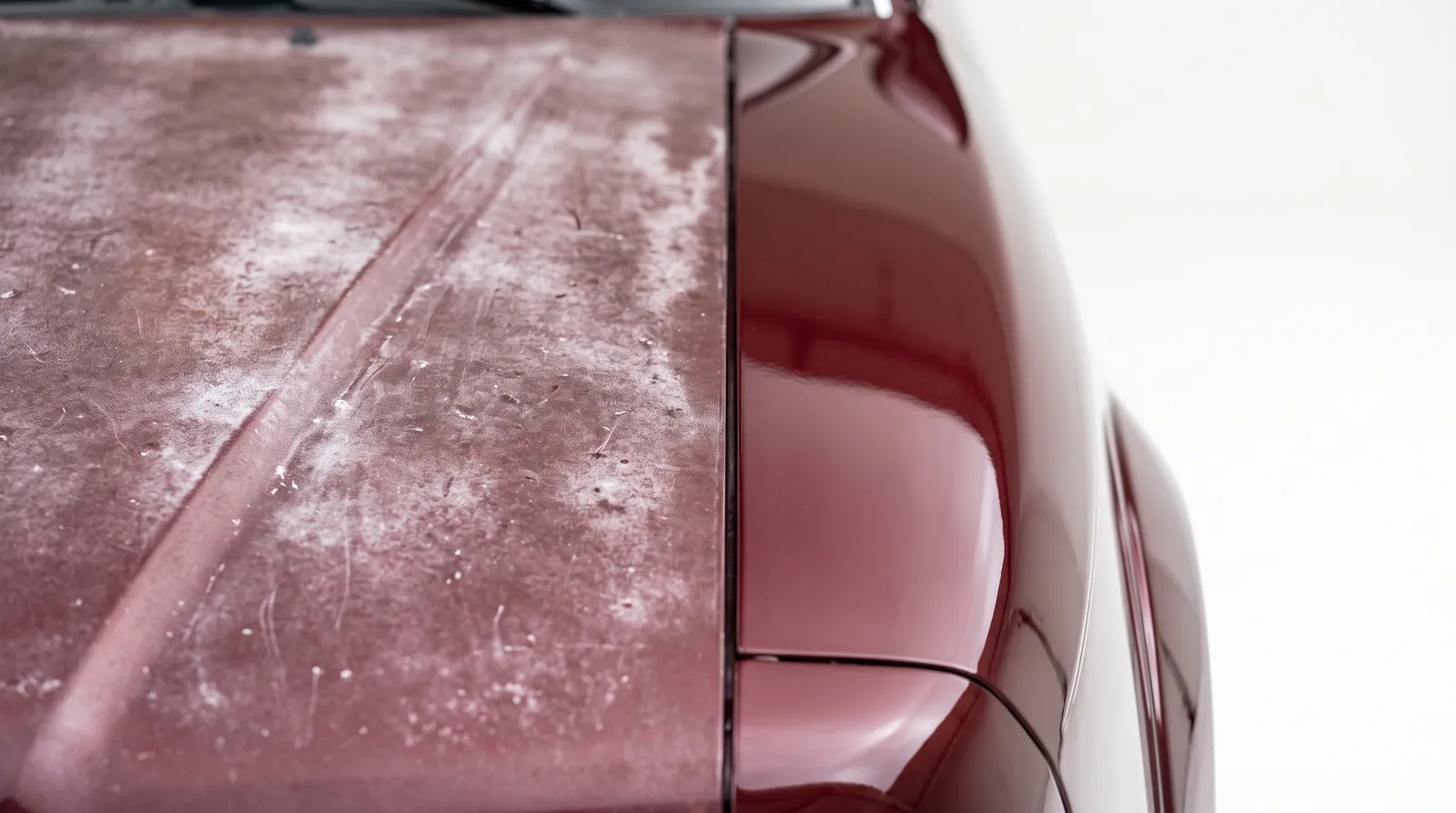
Paint oxidation happens when a clear coat's protective layer breaks down under prolonged UV exposure, leaving the paint looking dull, chalky, or faded rather than glossy — it's less a specific event than a gradual process that accumulates over years of sun exposure without adequate protection.
Paint restoration covers the range of techniques used to address this, from aggressive polishing that removes a thin layer of degraded clear coat to reveal fresher material underneath, to a full repaint when the damage is too far progressed for polishing to fix.
What Causes This
UV exposure is the primary driver — clear coat is engineered to absorb and block UV radiation that would otherwise degrade the paint underneath, but that protective capacity diminishes over years of exposure, especially for vehicles kept outdoors without regular waxing or ceramic protection. Environmental contaminants (tree sap, bird droppings, industrial fallout, salt air) accelerate the process if left on the paint for extended periods.
Darker colors tend to show oxidation more visibly since the chalky, dulled texture contrasts more starkly against a dark base than it does against a lighter one, though the underlying process affects all colors.
Signs to Look For
Early oxidation shows up as a subtle loss of depth and reflection rather than an obvious change — the paint still looks like its normal color but seems slightly flat compared to when the vehicle was new. As it progresses, a chalky white residue becomes visible, especially noticeable on darker colors, and can transfer onto a cloth wiped across the surface, a clear sign the clear coat is actively breaking down.
DIY vs. Professional Repair
Mild oxidation is genuinely addressable with DIY products — a quality oxidation-removing polish or compound, applied with a dual-action polisher or by hand with patience, can restore meaningful gloss to lightly oxidized paint. This is one of the more approachable DIY paint projects available, with a wide range of accessible products designed specifically for this purpose.
Severe oxidation, where the clear coat has genuinely failed (visible peeling, deep chalky texture that doesn't respond to polishing) is generally beyond what polishing can fix and requires a professional assessment for either a clear coat respray or, in advanced cases, a full repaint.
How the Repair Process Works
A typical restoration starts with a thorough wash and clay bar treatment to remove surface contaminants that would otherwise interfere with polishing. A cutting compound or polish appropriate to the oxidation's severity is then applied, usually with a dual-action or rotary polisher, in sections, gradually restoring clarity and gloss to the clear coat.
Once polishing is complete, a protective layer — wax, sealant, or ceramic coating — is applied to protect the restored finish and slow future oxidation. For clear coat failure beyond what polishing can address, the affected panels need to be sanded down and resprayed with fresh clear coat, or in severe cases, full repainting.
Working in smaller sections and checking your progress frequently prevents accidentally over-polishing one area while under-treating another, which is a common issue when tackling a full vehicle's oxidation in one long, fatiguing session.
Tools & Materials
A DIY restoration project needs a clay bar and lubricant for decontamination, a graduated set of cutting and polishing compounds (starting more aggressive for heavier oxidation, finishing finer for a glossy result), and either a dual-action polisher (safer for beginners) or genuine patience for hand application, plus a quality wax or sealant to protect the finished result.
Cost Factors
DIY oxidation removal costs relatively little — primarily the cost of polish, pads, and optionally a polisher rental or purchase. Professional polishing and paint correction services price based on the vehicle's size and the severity of oxidation, generally as a flat detailing service rather than a per-panel repair cost.
A full clear coat respray or repaint for severe, unrecoverable oxidation costs considerably more, priced similarly to any other full panel or vehicle repaint since it involves the complete paint process rather than just surface polishing.
Prevention
Regular waxing or ceramic coating is the single most effective prevention, maintaining a sacrificial UV-blocking layer on top of the factory clear coat rather than letting the clear coat absorb all UV stress directly. Covered or garaged parking dramatically reduces cumulative UV exposure over the vehicle's life.
Prompt removal of environmental contaminants — bird droppings, tree sap, bug splatter — prevents localized chemical damage that can accelerate oxidation in specific spots ahead of the surrounding paint.
Test any new polish or compound on a small, inconspicuous area first, since results can vary depending on your specific paint's age, hardness, and how severe the oxidation is — this avoids an unpleasant surprise on a highly visible panel.
Common Mistakes
A common mistake is over-polishing in an attempt to fix severe oxidation, which can remove so much clear coat material that it thins dangerously or breaks through to base coat entirely — there's a real limit to how much correction polishing can safely achieve, and pushing past it makes the underlying problem worse, not better.
Another common mistake is skipping protective wax or sealant after a successful restoration, which means the freshly restored finish starts accumulating new UV damage immediately with nothing to slow the process down.
A third common mistake is assuming all polishing products are interchangeable regardless of oxidation severity — using a finishing polish on heavy oxidation, or a heavy cutting compound on light oxidation, both give worse results than matching the product's aggressiveness to the actual condition.
Frequently Asked Questions
Can oxidized paint be fully restored to like-new condition?
Mild to moderate oxidation often responds very well to polishing, restoring most of the original gloss. Severe oxidation with genuine clear coat failure generally can't be fully restored through polishing alone and needs a respray.
How do I know if my paint is oxidized or just dirty?
Oxidized paint stays dull and chalky-looking even after a thorough wash, while dirty paint returns to a glossy finish once properly cleaned — a simple wash test is usually enough to tell the difference.
Does ceramic coating prevent oxidation?
Yes, significantly — a quality ceramic coating provides a durable UV-blocking layer that meaningfully slows the oxidation process compared to unprotected paint, though it doesn't make paint permanently immune to it.
How often should I polish my car to prevent oxidation?
This depends heavily on climate and storage conditions, but a general maintenance polish once or twice a year, combined with regular waxing, is a reasonable baseline for most owners in sunny climates.
Is oxidized paint dangerous or just cosmetic?
It's primarily cosmetic in its early stages, though severe, long-neglected oxidation can progress to clear coat failure and peeling, which does expose the base coat to more serious degradation over time.
Can dark colors recover from oxidation as well as light colors?
The underlying restoration process works the same regardless of color, though oxidation tends to be more visually obvious on dark colors both before and immediately after treatment, simply due to the contrast against the dark base.
Does a car cover help prevent oxidation for a vehicle parked outside?
Yes, a quality breathable car cover blocks direct UV exposure significantly and is a practical alternative when garaging isn't an option.
Is oxidized paint more prone to further damage like chips?
Somewhat — a compromised clear coat generally offers less protection against minor impacts and environmental damage than a healthy one, making restoration worthwhile beyond just appearance.
Will restoring oxidized paint remove my car's factory clear coat entirely?
A proper, moderate polish removes only a very thin layer of clear coat, well within the material's overall thickness — it's aggressive, repeated over-polishing across many sessions that risks thinning it dangerously.
Does a vehicle's age limit how much a restoration can improve it?
Very old, severely oxidized paint may not fully return to like-new condition, but meaningful visible improvement is achievable in the vast majority of cases with the right approach.
Does location affect the price?
Yes — labor rates and material costs vary meaningfully by region, so the same job can price differently between a major metro area and a smaller local market. Get quotes locally rather than relying on a national average.
Can a mobile detailer perform paint restoration, or does it need a fixed shop?
Mobile detailers can often handle standard polishing and oxidation removal effectively; more severe cases needing a respray require a proper shop with spray booth facilities.